Resources for local or home infusions

If your patient does not have a local infusion option, enter their location to find a nearby infusion provider authorized to administer Niktimvo™ (axatilimab-csfr)

While Incyte has attempted to provide a complete listing of sites that are qualified to offer Niktimvo infusions, this list may not be complete and some provider statuses may have changed. Incyte does not endorse, recommend, or guarantee the quality of care for any healthcare provider. Nor does Incyte guarantee that the information on this site is current. Please contact the infusion site directly to get the most up-to-date information. Please consult the NHIA or NICA for a complete list of home and local infusion locations.

Transitioning to local or home infusions

Patients receiving Niktimvo can access additional education and resources on transitioning to local or home infusions through IncyteCARES. Consider enrolling your patients today.

Evaluate patient readiness for transition based on:

Image
Two location pins separated by a short dotted line icon

Proximity to transplant center

Image
Dosing IV bag with octothorpe icon

Number of doses received

Image
Health Insurance card icon

Insurance considerations

There are 2 ways to submit the IncyteCARES enrollment form:

  1. Complete the online form here
    OR
  2. Download and fax the completed form to: 1-855-525-7207

Questions? Connect with IncyteCARES to learn more

Visit www.IncyteCARES.com or call 1-855-452-5234,

Monday through 
Friday, 8 AM – 8 PM ET.

FOR HEALTHCARE PROFESSIONALS

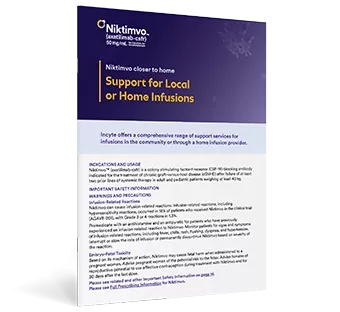
A complete guide to continuity of care  with Niktimvo
Image
Image of Support for local infusions brochure cover

Support for Local or Home Infusions

Download the Brochure

FOR YOUR PATIENTS

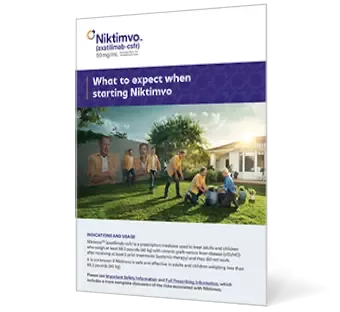
Information about cGVHD and the treatment journey with Niktimvo
Image
Image of What to Expect When Starting NIKTIMVO brochure cover

What to Expect When Starting Niktimvo

Download the Brochure

Frequently Asked Questions

Transplant centers

  • Provide clear communication of treatment plan, including laboratory parameters
  • Transfer clinical records
  • Provide clear expectations about when the local provider should reach out to the transplant center

Local providers

  • Ensure care staff is ready to receive the patient by being trained on Niktimvo and cGVHD and knows when to reach out to the transplant center
  • Obtain prior authorization, with the help of IncyteCARES if needed
  • Create order sets to assist in ordering and overall administration/care. IncyteCARES can provide order set guides upon request
  • Set up protocols for laboratory monitoring and infusion

Ongoing patient care, management of cGVHD, and coordination are led by the transplant center care team. Successful continuity of care relies on clear and consistent communication between the local provider and the transplant center.

Considerations for selecting a home infusion or infusion suite provider

  • Do they specialize in oncolytic products?
  • Do they have a trained and experienced nursing staff?
  • Do they provide support services, such as benefits verification, prior authorization, and patient monitoring?

IncyteCARES can provide:

  • Information on alternative site-of-care options, including providers, services, and coverage maps
  • Benefits investigations to discover whether home infusions may be an option for the patient
  • Benefits verifications to include information regarding the patient's healthcare plan prior authorization requirements

Field Access Managers are an extension of IncyteCARES and can provide:

  • Information on IncyteCARES
  • Information on transitioning the patient to a different site of care for transplant centers
  • Billing and coding support for local providers
  • Information and guidance for your staff, should your office encounter any access barriers (eg, delays, denials)

OCEs are tenured nurse clinicians with real-world experience who can provide valuable training on administration, monitoring, and patient and caregiver education.

cGVHD=chronic graft-versus-host disease; NHIA=National Home Infusion Association; NICA=National Infusion Center Association.

Explore additional resources


IMPORTANT SAFETY INFORMATION

WARNINGS AND PRECAUTIONS

Infusion-Related Reactions

Niktimvo (axatilimab-csfr) can cause infusion-related reactions. Infusion-related reactions, including hypersensitivity reactions, occurred in 18% of patients who received Niktimvo in the clinical trial (AGAVE-201), with Grade 3 or 4 reactions in 1.3%.

INDICATIONS AND USAGE

Niktimvo (axatilimab-csfr) is a colony stimulating factor-1 receptor (CSF-1R)-blocking antibody indicated for the treatment of chronic graft-versus-host disease (cGVHD) after failure of at least two prior lines of systemic therapy in adult and pediatric patients weighing at least 40 kg.

Premedicate with an antihistamine and an antipyretic for patients who have previously experienced an infusion-related reaction to Niktimvo. Monitor patients for signs and symptoms of infusion-related reactions, including fever, chills, rash, flushing, dyspnea, and hypertension. Interrupt or slow the rate of infusion or permanently discontinue Niktimvo based on severity of the reaction.

Embryo-Fetal Toxicity

Based on its mechanism of action, Niktimvo may cause fetal harm when administered to a pregnant woman. Advise pregnant women of the potential risk to the fetus. Advise females of reproductive potential to use effective contraception during treatment with Niktimvo and for 30 days after the last dose.

ADVERSE REACTIONS

Serious adverse reactions occurred in 44% of patients who received Niktimvo (N=79). Serious adverse reactions in > 2 patients included infection (pathogen unspecified) (14%), viral infection (14%), and respiratory failure (5.1%). Permanent discontinuation of Niktimvo due to an adverse reaction occurred in 10% of patients and dose reduction due to adverse reaction occurred in 8% of patients. Dose interruptions due to an adverse reaction occurred in 44% of patients. The adverse reactions leading to dose interruption in > 2 patients were viral infection, infection (pathogen unspecified), bacterial infection, musculoskeletal pain, and pyrexia.

The most common (≥ 15%) adverse reactions, including laboratory abnormalities, were increased aspartate aminotransferase (AST), infection (pathogen unspecified), increased alanine aminotransferase (ALT), decreased phosphate, decreased hemoglobin, viral infection, increased gamma glutamyl transferase (GGT), musculoskeletal pain, increased lipase, fatigue, increased amylase, increased calcium, increased creatine phosphokinase (CPK), increased alkaline phosphatase (ALP), nausea, headache, diarrhea, cough, bacterial infection, pyrexia, and dyspnea.

Clinically relevant adverse reactions in < 10% of patients who received Niktimvo included:

  • Eye disorders: periorbital edema
  • Skin and subcutaneous skin disorders: pruritus
  • Vascular disorders: hypertension

Immunogenicity: Anti-Drug Antibody–Associated Adverse Reactions

Across treatment arms in patients with cGVHD who received Niktimvo in clinical trials, among the patients who developed anti-drug antibodies (ADAs), hypersensitivity reactions occurred in 26% (13/50) of patients with neutralizing antibodies (NAb) and in 4% (2/45) of those without NAb.

USE IN SPECIFIC POPULATIONS

Lactation

Because of the potential for serious adverse reactions in a breastfed child, advise women not to breastfeed during treatment and for 30 days after the last dose of Niktimvo.

Females and Males of Reproductive Potential

Pregnancy Testing

Verify pregnancy status in females of reproductive potential prior to initiating Niktimvo.

Contraception

Females
Advise females of reproductive potential to use effective contraception during treatment with Niktimvo and for 30 days after the last dose of Niktimvo.

DOSAGE AND ADMINISTRATION

Dosage Modifications for Adverse Reactions

Monitor aspartate aminotransferase (AST), alanine aminotransferase (ALT), alkaline phosphatase (ALP), creatine phosphokinase (CPK), amylase, and lipase prior to the start of Niktimvo therapy, every 2 weeks for the first month, and every 1 to 2 months thereafter until abnormalities are resolved. See Table 1 in the Prescribing Information for more recommendations.

Please see Full Prescribing Information for Niktimvo.